Can a tooth be considered a success if it remains in your mouth but no longer supports your systemic vitality? For decades, conventional dentistry has focused on the structural survival of the tooth, often overlooking the delicate relationship between oral health and the rest of the body. When you explore the risks of traditional root canals, you begin to see a more complex picture than a simple procedure. You aren't just managing a localized infection; you're making a decision that impacts your immune system and overall inflammatory load.
It's natural to feel conflicted when faced with dental advice that seems to prioritize the tooth over the person. You want to feel confident that your dental work isn't a hidden burden on your health. This guide will help you understand the biological implications of leaving non-vital tissue in your jaw and introduce you to biocompatible alternatives that align with a wellness-first philosophy. We'll examine the science behind the oral-systemic connection, providing the clarity you need to choose a path that supports lasting harmony and technical excellence. By looking beyond immediate symptoms, you can make a choice that protects your long-term health and aesthetic confidence.
Key Takeaways
- Uncover the biological limitations of traditional sealing and how microscopic tunnels within the tooth can harbor hidden pathogens.
- Gain clarity on the risks of traditional root canals and the way chronic inflammation from non-vital tissue impacts your total-body immune health.
- Learn why advanced 3D Cone Beam imaging is a non-negotiable standard for a precise, modern evaluation of your oral-systemic connection.
- Explore biocompatible alternatives like zirconia dental implants that restore functional excellence while supporting your long-term wellness.
Understanding Traditional Root Canal Therapy: A Biological Overview
Traditional endodontic therapy is often described as a routine way to save a natural tooth. The process involves removing the dental pulp, which is the soft tissue containing nerves and blood vessels, and then cleaning, disinfecting, and sealing the interior space. You can find a detailed Root canal treatment overview that outlines these mechanical steps. In conventional dentistry, the ultimate victory is retaining the physical tooth structure. If the tooth remains in the socket and stays functional for chewing, the procedure is deemed a success. However, from a biological perspective, this definition of success is incomplete.
When we explore the risks of traditional root canals, we're looking at the biological shift from a living, vital organ to a non-vital structure. A vital tooth is integrated into your body's circulatory and immune systems. It's nourished and protected. A root-canaled tooth, by definition, is a dead tooth. It no longer receives blood flow, oxygen, or immune cells. This creates a biological dilemma. The body is required to host a dead piece of tissue within a living jawbone, often leaving the immune system in a state of chronic response.
The Concept of the Non-Vital Organ
Consider how the body reacts to dead tissue in any other area. Typically, the immune system works to remove it to prevent decay and systemic burden. In the mouth, the tooth is held in place by the periodontal ligament. This ligament acts as a bridge, allowing a dead structure to remain anchored. While this preserves your smile's appearance, the immune system may perceive this dead tissue as a foreign object. This leads to a persistent immune activation as your body attempts to address the stagnant environment inside the tooth. It's a delicate balance that can eventually impact your total-body wellness.
Success Rates: Clinical vs. Biological
Conventional metrics define success as a tooth that is asymptomatic and shows no dark spots on a standard X-ray. This perspective is limited. Traditional 2D imaging often misses low-grade infections hidden in the complex anatomy of the jaw. A tooth can be mechanically functional but remain a biological burden, forcing the immune system to manage a constant, subtle threat. Understanding the risks of traditional root canals means recognizing that a tooth can be saved mechanically while still challenging your systemic harmony. True wellness requires transitioning from a mindset of saving the tooth at any cost to one that prioritizes your systemic health.
The Micro-Anatomy of Risk: Dentinal Tubules and Hidden Pathogens
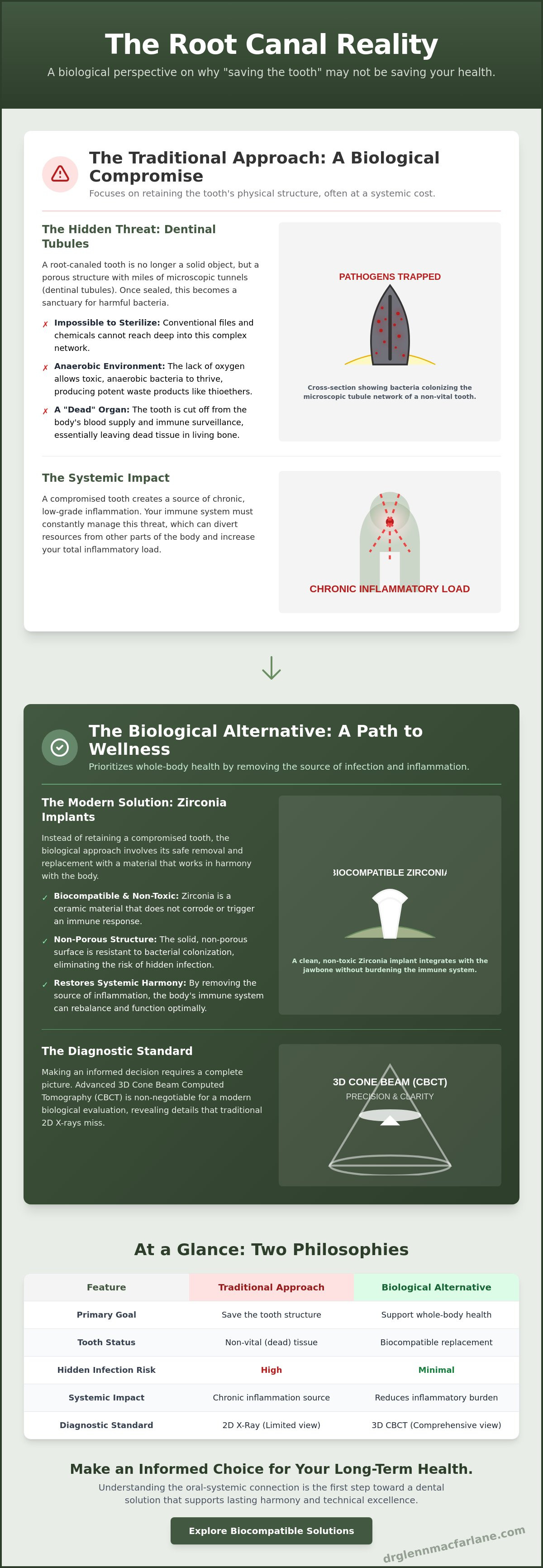
Imagine a tooth not as a solid, impenetrable block, but as a complex, porous organ. While the outer enamel appears dense, the underlying dentin is comprised of miles of microscopic tunnels known as dentinal tubules. In a healthy, vital tooth, these tubules are filled with fluid and protected by the body's immune system. However, once the pulp is removed during treatment, these tunnels become a vast, hollow labyrinth. This structural reality is central to the risks of traditional root canals. Conventional cleaning methods, which rely on metal files and chemical rinses like sodium hypochlorite, primarily address the main central canal. They often fail to penetrate the deep-seated recesses where pathogens can linger and thrive.
Standard protocols often emphasize the high success rates of the procedure, and you can review the official Root Canal Safety Information provided by the American Association of Endodontists for a conventional perspective. From a biological standpoint, however, the challenge lies in what remains behind. When the tooth is sealed, it creates an oxygen-free environment. This lack of oxygen triggers an "anaerobic shift," where previously benign bacteria transform into highly resilient, toxic pathogens. These anaerobic organisms are capable of producing potent metabolic byproducts that may eventually interact with your systemic health.
The Sterilization Challenge
Physics and biology often collide within the narrow confines of a tooth. The surface tension of traditional chemical irrigants frequently prevents them from flowing into the microscopic tubule system. While mechanical filing clears the central "highway," the thousands of miles of "side streets" remain largely untouched. Inside these sealed spaces, bacteria can produce thioethers and mercaptans. These are highly toxic compounds that can seep through the porous tooth structure and into the surrounding periodontal ligament and bloodstream. For those prioritizing total-body wellness, a biological dental evaluation can help determine if existing dental work is contributing to a silent inflammatory burden.
Biofilms and Persistent Infections
Pathogens are rarely solitary; they often organize into protective structures called biofilms. These slimy layers act as a shield, making bacteria like Enterococcus faecalis remarkably resistant to traditional disinfection and even systemic antibiotics. When these colonies persist at the root tip, they can cause chronic, low-grade apical periodontitis. This is a subtle, often painless form of inflammation that keeps the immune system on constant high alert. The risks of traditional root canals involve this potential for long-term immune distraction, where the body's resources are perpetually diverted to manage a localized but persistent biological threat.
Systemic Connections: How a Root Canal Affects Total-Body Wellness
The mouth is often the most overlooked gateway to total-body health. While conventional dentistry frequently treats a tooth as an isolated mechanical structure, modern immunology suggests a far more integrated reality. Understanding the risks of traditional root canals requires looking beyond the jawbone to the heart, joints, and immune system. The oral-systemic link is a well-documented connection where chronic oral pathogens and their inflammatory byproducts enter the bloodstream. This can lead to a persistent state of immune activation that contributes to cardiovascular strain and autoimmune dysfunction. While conventional resources like the Mayo Clinic on Tooth Infections emphasize the necessity of treating an abscess to prevent acute spread, biological dentistry looks at the long-term systemic consequences of the treatment itself.
Biological dentistry is currently revisiting the Focal Infection Theory through the lens of 2026 clinical standards. This theory suggests that a localized infection can cause symptoms in distant parts of the body. In the context of modern biological standards, a focal infection is defined as a localized area of necrotic tissue or pathogenic colonization that serves as a persistent source of systemic toxicity and chronic inflammation. When a dead tooth is left in the mouth, the body's defense systems are perpetually engaged, attempting to manage a threat they can never fully eliminate.
Meridian Theory and Energetic Pathways
Traditional Chinese Medicine has long recognized the interconnectedness of health through meridian pathways. Each tooth sits on a specific energetic meridian that corresponds to various organs and systems. For example, the upper first molars are linked to the stomach and pancreas, while the front teeth are connected to the kidney and bladder. When evaluating the risks of traditional root canals, biological practitioners often observe that a chronic issue in a specific tooth correlates with health challenges in its corresponding organ system. Many patients report significant systemic improvements after addressing these dental focal infections, finding relief from long-standing health concerns that previously seemed unrelated to their oral health.
Chronic Immune Activation
The presence of a non-vital tooth can create a "toxic bucket" effect. Your body has a finite capacity to handle environmental and biological stressors. A root-canaled tooth can act as a constant drip of cytokines and bacterial toxins into this bucket. This persistent immune distraction can lead to the following issues:
- Systemic Inflammation: A steady release of inflammatory markers that can affect joint health and arterial walls.
- Jawbone Cavitations: "Silent" areas of necrotic bone that often develop at the site of previous root canal complications or extractions.
- Immune Fatigue: A state where the immune system becomes overtaxed and less efficient at responding to other health challenges.
By viewing the tooth as a vital organ with systemic connections, we can move toward a model of care that prioritizes your long-term harmony and safety.
Modern Diagnostics and Evaluating Your Options
Modern diagnostics have moved beyond the simple "wait and see" approach. In biological dentistry, we prioritize precision and clarity over guesswork. This shift is essential because the risks of traditional root canals often manifest in ways that a standard clinical exam cannot detect. We don't just look for pain or visible decay; we look for systemic harmony. Evaluating an existing root canal requires a comprehensive understanding of how that structure interacts with your unique biology and immune system.
The decision to monitor, retreat, or remove a non-vital tooth isn't one-size-fits-all. It requires a deep dive into the tooth's current state and its impact on your "toxic bucket." By utilizing advanced tools, we can move from a place of uncertainty to a place of informed confidence. This ensures that your dental plan aligns with your long-term wellness goals rather than just addressing a localized symptom.
The Power of CBCT 3D Imaging
Traditional 2D X-rays are often compared to looking at the shadow of a tree rather than the tree itself. They provide a flat perspective that can easily hide complex anatomical details. This is why 3D Cone Beam (CBCT) imaging is non-negotiable for a thorough biological evaluation. Dr. MacFarlane utilizes Digital X-rays and 3D Cone Beam Imaging to gain diagnostic clarity that was previously impossible. This technology allows us to identify "silent" infections, hidden accessory canals, and subtle bone loss that might be contributing to a systemic inflammatory burden without ever causing a localized toothache. Seeing the tooth in three dimensions is the only way to truly assess the risks of traditional root canals you may already have.
Material Sensitivity and Biocompatibility
The materials used to seal a tooth are just as important as the procedure itself. Traditional gutta-percha and certain chemical sealers may not be compatible with everyone’s immune system. Biocompatibility Testing provides a scientific window into your body’s specific sensitivities. By using a blood test, we can identify which materials are most likely to harmonize with your unique biochemistry. This ensures that any intervention, whether it's a new restoration or a full mouth reconstruction, supports your health rather than challenging it. If you are concerned about how your dental history is affecting your wellness, you can schedule a comprehensive biological consultation to explore your options with clarity and confidence.
Biological Alternatives and the Path to Healing
Choosing a path forward requires a fundamental shift in perspective. While conventional wisdom suggests saving a tooth at any cost, biological dentistry recognizes that some costs are simply too high for your systemic vitality. When the risks of traditional root canals, including chronic inflammation and persistent pathogens, compromise your wellness, extraction becomes the most health-conscious choice. This isn't an admission of failure; it's a proactive step toward systemic harmony. A biological extraction involves more than just removing the tooth. It requires the meticulous removal of the periodontal ligament and necrotic bone to ensure the site heals fully without leaving a silent infection or cavitation behind.
The goal is to move from a state of immune distraction to a state of regenerative healing. By addressing the root cause of systemic stress, you allow your body to redirect its energy toward long-term health. This journey involves utilizing advanced materials and therapies that respect your unique biochemistry and support your body's natural ability to recover. You aren't just replacing a tooth; you are restoring a vital part of your oral-systemic balance.
Zirconia Implants: The Metal-Free Standard
Once a non-vital tooth is removed, the focus shifts to functional and aesthetic restoration. Zirconia dental implants have emerged as the premier biocompatible solution for tooth replacement. Unlike traditional titanium implants, zirconia is a bio-inert ceramic material. It doesn't corrode, trigger metal sensitivities, or interfere with the body's energetic meridians. You can explore the benefits of zirconia dental implants to understand how these restorations offer superior gum tissue health and a natural, light-reflective aesthetic that rivals your original teeth. It's a sophisticated choice for those who refuse to compromise on safety or beauty.
Advanced Infection Control with Ozone
Modern biological protocols utilize nature's most powerful antimicrobial: oxygen. Integrating ozone therapy into restorative procedures allows for a level of disinfection that traditional liquids cannot achieve. As a gas, ozone penetrates deep into the surrounding bone and microscopic tubules, eradicating bacteria, viruses, and fungi on contact. This process also stimulates local blood flow and enhances the immune response, accelerating the healing process. By using ozone during a biological extraction, we ensure the site is truly sterile and prepared for a successful, biocompatible restoration.
Choosing a Biological Partner
Your health journey deserves a guide who looks beyond the immediate symptoms to see you as a whole person. When searching for a biological dentist, look for a practitioner who understands the SMART protocol and prioritizes systemic wellness. The risks of traditional root canals are manageable when you have a partner committed to technical excellence and professional gravitas. Prioritize your long-term vitality over short-term convenience. By choosing biocompatible alternatives, you're making a decision that supports a lifetime of health, safety, and aesthetic confidence.
Embracing a Future of Systemic Vitality
Prioritizing your wellness means looking beyond the surface of a single tooth to the vibrant health of your entire body. We have explored how the intricate micro-anatomy of your teeth and the materials used in your restorations can influence your long-term vitality. Understanding the risks of traditional root canals is a vital first step in reclaiming your systemic harmony. By choosing precision diagnostics and biocompatible alternatives, you move from simply managing symptoms to cultivating a state of true, lasting health.
Your journey to healing is supported by a legacy of trust and technical excellence. With over 35 years of clinical excellence, Dr. MacFarlane utilizes advanced 3D CBCT diagnostic technology and SMART certified mercury-safe protocols to ensure your safety and aesthetic refinement. You don't have to navigate these complex health decisions alone. Schedule your systemic health consultation with Dr. MacFarlane today to partner with a guide who values your total-body wellness as much as your smile. Your path to a healthier, more vibrant future is clear and within reach.
Common Questions About Biological Endodontics
Can a root canal cause systemic illness?
While traditional dentistry views the procedure as localized, biological perspectives suggest that a non-vital tooth can act as a persistent source of systemic strain. Pathogens trapped within the microscopic tubule system produce metabolic toxins that can enter the bloodstream. This constant immune challenge may contribute to chronic inflammation, potentially impacting heart health or autoimmune function. It's a matter of looking at the body as an integrated system rather than isolated structures.
What are the symptoms of a 'failing' or toxic root canal?
Symptoms are often subtle and systemic rather than localized dental pain. You might experience persistent fatigue, joint discomfort, or unexplained immune flare-ups that don't seem related to your mouth. Because the nerve is removed, a "clinically successful" tooth may not hurt even if a low-grade infection is present. Precision diagnostics are often required to identify these silent inflammatory burdens that standard exams might overlook.
Is there a safe way to perform a root canal?
Biological protocols aim to minimize risks by utilizing advanced disinfection and biocompatible materials. We focus on maximizing the eradication of pathogens through Ozone Therapy, which penetrates where traditional liquids cannot reach. While no procedure involving a non-vital tooth is entirely without risk, these sophisticated methods prioritize your systemic harmony. The goal is to create the most sterile and biocompatible environment possible for the remaining tooth structure.
What is the best alternative to a traditional root canal?
The primary biological alternative is a health-conscious extraction followed by a biocompatible replacement. This path removes the source of potential toxicity entirely rather than attempting to manage a dead organ. We follow specific protocols to ensure the periodontal ligament and any necrotic bone are removed, allowing the site to heal fully. A zirconia dental implant is then used to restore function and aesthetics without introducing metals into your jaw.
How do I know if my existing root canals are affecting my health?
The most reliable way to assess your dental work is through 3D Cone Beam (CBCT) imaging. This technology reveals hidden infections and bone loss that traditional 2D X-rays often miss. We also consider your overall health history and any persistent systemic symptoms. By evaluating the tooth's position on energetic meridians, we can gain a clearer picture of how your oral health may be interacting with your total-body wellness.
Are zirconia implants safer than root canals?
Zirconia implants are often considered a more health-conscious choice because they are bio-inert and metal-free. They replace the missing tooth with a living, integrated foundation rather than hosting a dead structure in the jawbone. This approach eliminates the risks of traditional root canals, such as the colonization of anaerobic bacteria in the dentinal tubules. For many, this provides a cleaner biological solution that supports long-term immune stability.
Zirconia implants are often considered a more health-conscious choice because they are bio-inert and metal-free. They replace the missing tooth with a living, integrated foundation rather than hosting a dead structure in the jawbone. This approach eliminates the risks of traditional root canals, such as the colonization of anaerobic bacteria in the dentinal tubules. For many, this provides a cleaner biological solution that supports long-term immune stability; to learn more about these biocompatible options, you can visit Star Dental Care and explore their multi-award-winning approach to restorative dentistry.
What is the 'focal infection' theory in modern dentistry?
This theory suggests that a localized area of infection or necrotic tissue can serve as a source of pathogens for the entire body. In modern biological dentistry, we view a root-canaled tooth as a potential focal infection if it harbors anaerobic bacteria. These organisms release toxins that travel through the blood and lymph, potentially affecting distant organs. Addressing these focal points is often a key step in resolving chronic, systemic health challenges.
Does every root canal need to be removed?
Not every root-canaled tooth requires immediate removal; the decision is highly personalized. We base our recommendations on diagnostic evidence from 3D imaging and your individual health goals. If a tooth shows no signs of infection and your systemic health is thriving, we may simply choose to monitor it. However, if you are struggling with chronic illness, removing a biological burden can be a transformative step in your path to healing.